


By Maayan Hoffman
Special to THE JEWISH JOURNAL
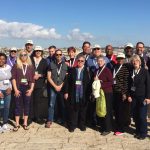
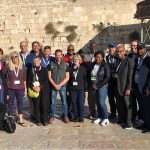
A rabbi and a reverend have two religions and sometimes different approaches to everyday life. However, more than two dozen rabbis, reverends and other faith and communal leaders of various backgrounds found common ground in the Holy Land from November 29 to December 8. They traveled together through Israel on a journey they described as joyful, humorous, sometimes painful, but mostly spiritual.
The clergy, all leaders in the Buffalo community or surrounding area, were brought together by the Buffalo Jewish Federation, in partnership with the National Federation for Just Communities (NFCJ). The purpose of the trip was spiritual and not geopolitical, explained Federation CEO Rob Goldberg, whose organization underwrote much of the trip
“This is a spiritual journey, with Jews and non-Jews, including Evangelical Christians, Protestants, Catholics, women and men – it is amazing,” Goldberg told The Jewish Journal.
He said the mission was part of Federation’s ongoing efforts to revitalize the area’s community relations efforts – “For 15 years there was some bridge-building with the non-Jewish community, but we need much more.” The goal was for travelers to meet and form deeper relationships with one another. This, said Goldberg, could lead to opportunities for collaboration in times of tragedy or joy.
“My hope is that in Buffalo, next time there is a march, or a holy building is desecrated, we can tackle it together,” he said, noting that for a community like “little Buffalo, it is amazing that we could pull this off.”
The tour was led by Makor Educational Journeys. Participants crossed Israel, from Jerusalem – which received its official recognition as the capital of Israel by US President Donald Trump two days before the end of the mission – to Samaria in the West Bank, the Galilee and Tel Aviv.
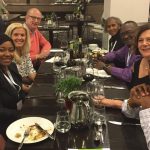
They heard from some of the country’s most renowned faith leaders, including the Very Revd. Hosam E. Naoum, Dean of St. George, for a discussion on the challenges of interfaith dialogue in Jerusalem. Rabbi Michael Melchior, an interfaith activist and former government minister, who talked about religion as a bridge between Israelis and Palestinians. They had dinner one evening with Deacon Jiries Nasur and Rabbi Mark Rosenstein, who together discussed their relation to the land and the Bible.
In Jerusalem, participants ascended to the Mount of Olives and then walked through the ancient and holy city’s Jewish and Christian quarters, including stopping at the Cenacle, also known as the “Upper Room,” a room in the David’s Tomb Compound in Jerusalem, traditionally held to be the site of the Last Supper.
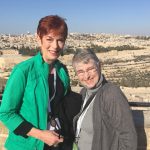
Goldberg went into the Cenacle with Sister Margaret Carney, president emeritus of St. Bonaventure University, a co-ed Franciscan Catholic university in Olean, New York. Catholics believe the Cenacle is not only where Jesus ate his last, fateful meal, but also where the holy spirit alighted upon the eleven Apostles after Easter.
“It was quite moving to experience the Cenacle with Sister Margaret and other members of the trip,” said Goldberg.
Visits to various holy sites sparked debates about how much faithful people should and could rely on archeology and science to prove their beliefs. The group’s private tour guide Joe Freedman tried to give perspective on the subject, explaining that there are few things that experts can prove or disprove. Rather, when it comes to whether Jesus was buried “here or 50 yards further over there,” it doesn’t really matter in the long run.
“What is important is faith and tradition,” Freedman said.
“I haven’t had a lot of time to sit and compare pages of the Bible and my belief system with what we are seeing, but I think that time will come when we decompress on the backside,” said Rev. Al Warner, founder and director of Set Free Inc. Warner said he heard from several people that there is a feeling for Christians of coming home when they walk on the “sacred soil of Israel, and it is true that as you step into the place we have spoken about and preached about for years, there is all kinds of new meaning, layers of new meaning, that seem to come to life.”
It also brought new recognition to certain likenesses between all monotheistic religions.
“I am beginning to see the similarities of the common spirit,” said Dr. G. Stanford Bratton, executive director of the Network of Religious Communities, a few days into the journey.
The first Friday night in Israel, the group experienced an explanatory Kabbalat Shabbat at the egalitarian section of the Western Wall. On Sunday morning, Rev. Greg Jakubowicz of St. Joseph University Parish presented an interactive mass for participants, followed by “tag-team preaching,” led by Warner, his wife Deb, and Rev. Mark E. Blue of the Second Baptist Church in Lackawanna, Bishop Darius G. Pridgen, senior pastor of True Bethel Baptist Church, his wife Monique, and son, Pastor Craig Pridgen.
“The highlight was the Western Wall and seeing the vibrancy of the Jewish young people on Shabbat,” said Bishop Pridgen. “I witnessed young people running to the wall and wanting to be close to God. I will return home with a goal of digging deeper into what caused that type of excitement and that dedication to want to get to that wall. That is the excitement that any Christian pastor would want their congregation to experience.”
Jakubowicz led his service wearing a traditional cassock and rope belt. He used the floor to give thanks to the Jewish Federation for pulling the group together despite their differences in faith.
“We have one core – that one God,” said Jakubowicz, who then called on participants to rise and “offer each other a sign of peace.” Each visitor rose and for nearly five minutes circled the conference room in which the service took place, hugging and blessing one another.
Bratton read Psalm 107, which talks about “those He gathered from the lands, from east and west, from north and south.” Then offered a personal prayer that the mission will help participants “see the world in a new way, hear voices unfiltered by prejudices, and open our hearts that we might build bridges of respect, understanding and finally love.”
The tag-team preaching focused on building unity, too. Warner gave an example of “unity gone wrong” in the immovable ladder in the Church of the Holy Sepulchre in Jerusalem, which the group had visited the day before.
Warner said when you gaze to the upper-story windows on the main façade, just beneath the window on the right, you’ll find a ladder that has been there for three centuries. It cannot be moved because, as per the Status Quo Agreement on the church, six Christian groups must come to total agreement about how something should be improved, cleaned or fixed, or nothing at all can happen. The ladder serves as a reminder of the Christians’ long-standing divisions.
In contrast, Warner told the story of the Jewish prophet Nehemiah, who pulled the Jewish people together to rebuild the walls of Jerusalem in 52 days; the walls had been down for 147 years. He explained that just as Nehemiah empowered each member of the community to build the section of the wall in front of his own house and then interconnect that section with his neighbor’s, this was the people’s charge today.
Warner said walls are built when the rough edges interlock. “Unless we interlock the blocks, the wall falls over,” he said. He noted that until now Buffalo has had its share of challenges, but he thinks that God is ready to build it up – and part of that building is the Buffalo Jewish Federation’s Clergy Interfaith Mission to Israel.
“God likes to build broken places, to build cities like Buffalo,” he said.
A lot of amens led to a spontaneous rendition of “Kumbaya My Lord.” The crowd stood in chorus together, swaying, in some cases, their arms interlocked.
Warner said that on the tour every day had a script, but the most powerful moments were the unscripted ones. For example, when the group was by the Tomb of the Virgin Mary, a group of women from the Philippines spontaneously started singing a hymn about the virgin mother.
“At first, the Christian members of the group didn’t think they knew the song because the women were singing the words in their language,” recalled Rabbi Alex Lazarus Klein of Congregation Shir Shalom. “Then they got to the chorus and all the Christian participants suddenly knew the melody and words. They sang the song together.
“Whether that is the real burial place of Mary or not, it became a holy moment in a holy place.”
Klein said it is not yet clear whether the tour will have immediate impact on the Buffalo community, but he does feel that his friendships have deepened, and a new level of trust has been built.
“We became more than colleagues,” said Cantor Irwin Gelman of Congregation Beth Abraham. “These are my new brothers and sisters in faith.”
“I was afraid to come over here, but my fear is gone,” added Reverend Blue. “God is telling us today we need to get our act together.”
Click to Enlarge