


 Admin
Admin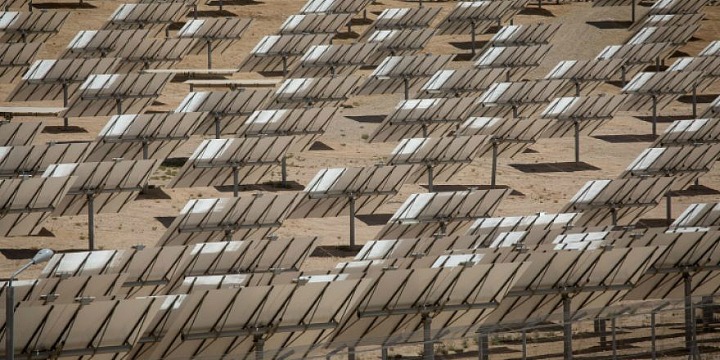
View of the Ashalim solar-power station in the Negev Desert on June 19, 2018. The station is the largest of its kind in Israel and fifth-largest in the world. Photo: Miriam Alster/Flash90.
CTech – Within a decade, 43 percent of Israel’s electricity could be solar, according to a report released earlier this month by Israel’s Ministry of Environmental Protection. By 2030, this capability could be reached solely by relying on solar panels installed on buildings, greenhouses, and built infrastructure, without encroaching on open areas and fields, the report said. The current target set by the government is to have 17 percent of the country’s electricity produced using sustainable sources by 2030.
On Wednesday, the Israeli Ministries of Finance and Energy and The Israel Public Utility Authority for Electricity published a joint tender for the construction and maintenance of a 300-megawatt solar power plant, set to become the country’s largest solar power producer. The plant, expected to be completed in 2023, will be built across 3 square kilometers near southern Israeli city Dimona.
Israel will be able to produce 80 percent of its electricity using only solar panels by 2050, enabling it to reduce its emissions drastically, the environmental protection ministry stated in its report.
In 2009, Israel set a target of 5 percent green electricity by 2014, and 10 percent by 2020. As of May 2019, it was incredibly behind on its goal, barely scraping by at 6.5 percent. In a July interview with Calcalist, Christiana Figueres, the former Executive Secretary of the UN Framework Convention on Climate Change (UNFCCC), said that Israel has the capability to produce 100 percent of its own electricity from sustainable sources and called the country’s reliance on fossil fuels “suicidal.”