

Buffalo ,NY
Powered by Hebcal Shabbat Times
Extras
[elementor-template id="3993"]
One Stop Jewish Buffalo
Menu
  • Buffalo Jewish Review Anthology 2010
  • Books
  • BUFFALO HAPPENINGS
    • Close
      • WHAT’S NEW
        • Close
          • finalBuffalo Jewish Review Anthology
          • Nickel City Jews, ShabbatNCJ Graduate E-Marketing Seminar & Shabbat Dinner
          • Commission Here ProHillel Sophomore E-Marketing Workshop & Shabbat Potluck Dinner

          • All News
        • Close
      • ORGANIZATIONS
        • Close
          • JEWISH EDUCATION
            • Close
            • ohr-temimim buffalo jewish heritage day schoolOhr Temimim
            • Kadimah-AcademyKadimah Academy
            • ubUNIVERSITY AT BUFFALO
            • pj-libraryPJ Library
            • Hebrew-High-of-Buffalo,-NYBJE Hebrew High
            • chaichai Hebrew School
            • Close
          • Health Services
            • Close
            • jfsJEWISH FAMILY SERVICES
            • Close
          • Theatre
            • Close
            • theaterJEWISH REPERTORY THEATRE
            • Buffalo International Jewish Film FestivalBUFFALO INTERNATIONAL JEWISH FILM FESTIVAL
            • Close
          • Art
            • Close
            • artBUNIS FAMILY ART GALLERY
            • Close
          • Buffalo Jewish Federation
            • Close
            • Buffalo Jewish FederationBUFFALO JEWISH FEDERATION
            • Close
          • JCC
            • Close
            • J-logo-to-be-used-formattedJewish Community Center
            • Close
          • Aliyah Program
            • Close
            • exodus-logoOperation Exodus
            • Close
          • Holocaust Resource Center
            • Close
            • Holocaust Resource CenterHOLOCAUST RESOURCE CENTER OF BUFFALO
            • Close
        • Close
      • EATERIES
        • Close
        • eateries in buffaloEat-In
        • cateringCatering
        • butcherButcher
        • Close
      • SYNAGOGUES
        • Close
        • knesset center chabadORTHODOX
        • temple-beit-tzedekCONSERVATIVE
        • Congregation-Beth-AbrahamCONSERVATIVE / FAMILY ORIENTED
        • shir-shalomREFORM / RECONNSTRUCTIONIST
        • Temple-Beth-ZionREFORMS
        • chai-300×200UNAFFILIATED
        • Close
    • Close
  • WORDS OF TORAH
    • Close
    • Rabbi Ori BergmanRABBI ORI BERGMAN
    • altRabbi Yosef Alt
    • RABBI ALEXANDER LAZARUS-KLEINRABBI ALEXANDER LAZARUS-KLEIN
    • Rabbi Heschel GreenbergRABBI HESCHEL GREENBERG
    • RABBI JONATHAN FREIRICHRABBI JONATHAN FREIRICH
    • RABBI NOSSON SPERORABBI NOSSON SPERO
    • Close
  • OBITUARIES
    • Close

      • All Obituaries
    • Close
  • BUFFALO JEWISH ARCHIVES
  • Jewish News
  • ABOUT
  • CONTACT
    • Close
    • Close
Home » Israel News » Mideast States Must Share More Information on Coronavirus Cases: WHO

Mideast States Must Share More Information on Coronavirus Cases: WHO

Admin March 19, 2020 12:03 pm Comments Off on Mideast States Must Share More Information on Coronavirus Cases: WHO

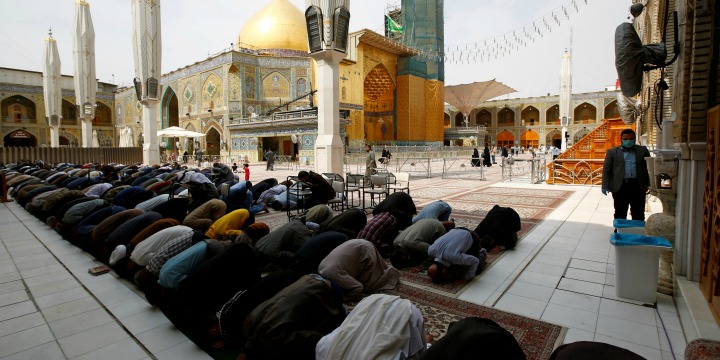
Shi’ite Muslim pilgrims pray at Imam Ali Shrine after Iraq’s Najaf authorities banned all non-residents visits, following the coronavirus outbreak, in the holy city of Najaf, Iraq, March 16, 2020. Photo: Reuters / Alaa al-Marjani / File.

The World Health Organization (WHO) said on Wednesday that Middle East states needed urgently to offer more information about coronavirus cases to help bolster the fight against the disease across the region.

Ahmed Al-Mandhari, WHO Regional Director for the Eastern Mediterranean, said the regional approach to fighting the coronavirus had so far been “uneven” and that much more should be done.

Improved access to information would allow the WHO to track its spread closely and quickly apply proven public health measures, Mandhari told reporters in a video-conference briefing.

“Unfortunately, even today, as the situation is becoming critical, information on cases is insufficiently communicated by countries to WHO,” Mandhari said, referring to “under-reporting on the part of some countries with regard to positive cases.”

The WHO had seen efforts to strengthen surveillance, scale up testing and support families who are isolating relatives or in quarantine, he added, but some states were not fully engaged.

“Frankly we are seeing uneven approaches across the region. While we have observed impressive progress in several countries, not all are yet applying the whole of government and whole of society approach.”

“The time to act is now. I cannot stress enough the level of urgency.”

Across much of the region outside Iran — which is one of the worst affected countries worldwide — the number of confirmed cases has been relatively low compared to east Asia and Europe but WHO officials fear real figures could be considerably higher than reported due to a lack of testing and a prevalence of mild cases.

So far, Mandhari said just over 18,000 cases had been confirmed in 18 countries in the WHO’s Eastern Mediterranean region, which includes Pakistan and Afghanistan as well and Middle Eastern and North African states. That includes 1,010 deaths in seven countries.

Border closures

Countries have to strike a balance between protecting health and minimizing economic and social disruption, he said, adding that border closures that can impede healthcare supplies and assistance were not generally recommended.

Two-thirds of countries in the region suffer from crises that have impacted health systems. Millions of refugees and displaced people living in camps could be especially vulnerable.

UN agencies have released guidance about recommended action in such camps, said Rick Brennan, emergency director for the region.

At camps in northwest Syria, measures were being taken to improve surveillance systems, set up testing and establish isolation facilities for the sick, as well as accelerating outreach to community about the risks, he said.

Asked about prisons, Brennan stopped short of advising the mass release of prisoners such as in Iran, but said authorities should implement measures such as spacing out beds within dormitories and reinforce hygiene measures.

“The general measures around hygiene and social distancing become even more important in overcrowded and congested settings such as prisons, camps, dormitories and elsewhere,” said Brennan.

Admin |View all posts by Admin


« Previous Post
Next Post »

Shabbat in Buffalo
Powered by Hebcal Shabbat Times
ILTV Weekly Recap
Nachum's Column
Out of the Box
Nachum's Column

Out of the Box

At theWeinberg Achim brotherhood program a couple of weeks ago Rob Goldberg the executive director of the Jewish Federation spoke.

Read More »
The Infrahuman: Animality in Modern Jewish Literature
Nachum's Column

The Infrahuman: Animality in Modern Jewish Literature

Professor Noam Pines from the University of Buffalo, Department of Jewish thought, presented his new book last week in Clemens 

Read More »
spacer
spacer
Powered by Hebcal Shabbat Times

DON’T WORRY EVERYTHING IS OK

  In Israel, there is a very common phrase used here; “Al Tidag Hakol Bseder” (Don’t worry everything is ok).

Read More »

BROTHERLY LOVE, BROTHERLY HATE

This past Thursday was a momentous milestone for the State of Israel as she celebrated her 70th birthday. Sparking emotion

Read More »

A DEEP DIVIDE

The bond between Israel and the United States has never been as strong as it has been this past year.

Read More »
All Posts
Shabbat Times
Powered by Hebcal Shabbat Times
[elementor-template id="3804"]
Extras
[elementor-template id="3993"]
2017 - All Rights Reserved to One Stop Jewish Buffalo
Design by Buffalo-Booster
Scroll to top